
 info@trade-jp.net


 menu

News / Blog
ATTENTION! September Holidays!
Catalog


| Product Code | |
| Availability | 13 |
| Price | USD 259.00 |
| Qty |
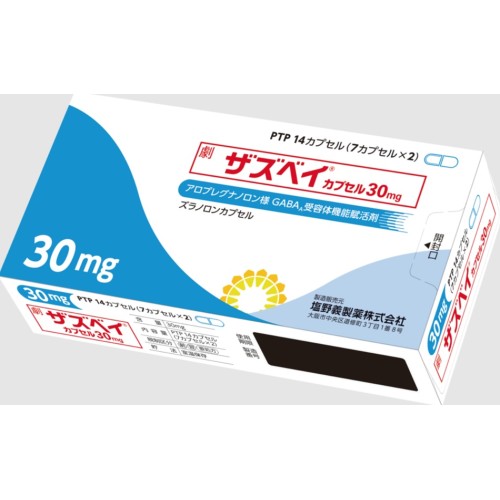
Zurzuvae Capsules 30 mg for depression and depressive state (zuranolone)
Product Code :
Availability : 13
USD 259.00
Are Zurzuvae Capsules 30 mg effective for depression and depressive state (GABA-A receptor positive allosteric modulator)?
What are Zurzuvae Capsules 30 mg?
Zurzuvae Capsules 30 mg are a prescription medicine for adults with depression and depressive state. Each capsule contains 30 mg of zuranolone as white powder. It was approved in Japan in December 2025 and went on sale in March 2026, and it was the first antidepressant approved in Japan with this mechanism of action. It is used for the acute phase of a depressive episode and not to prevent relapse or recurrence after symptoms have improved. A treatment course lasts 14 days, so one pack of 14 capsules makes up one course.
What is depression, and why is a short treatment course used?
Major depressive disorder is a condition of persistent low mood, loss of interest and energy, sleep and appetite changes and difficulty concentrating, and it affects an estimated 5 million people in Japan. Conventional antidepressants often take several weeks to show their effect. Zuranolone was developed to act within days, and in clinical trials the first changes in symptom scores were measured within the first two weeks of treatment. Because it is taken for 14 days and then stopped, it is used as a short course. Between courses, doctors continue to follow the patient and may add psychotherapy and other non-drug care according to the patient’s condition.
How does zuranolone work?
GABA is the main inhibitory messenger of the brain, and it calms nerve cell activity. Zuranolone is a synthetic neuroactive steroid with a structure resembling allopregnanolone, a natural steroid of the body. It is a positive allosteric modulator of GABA-A receptors. It does not replace GABA. It strengthens the response when GABA binds, at receptors located at the receiving side of the synapse and at those outside the synapse.
In laboratory tests, zuranolone increased both the brief and the sustained inhibitory currents that GABA produces in nerve cells. In a mouse model of depression caused by social defeat stress, treated mice spent more time with other mice starting on the first day of dosing. Zuranolone is taken up slowly: after a 30 mg dose in healthy adults, the blood level peaked after about 5 hours, and the half-life was about 14 hours. It is largely bound to blood proteins (over 99.5%) and is broken down in the liver, mainly by the enzyme CYP3A.
What clinical studies show
Three Japanese studies, all sponsored by the developer, form the basis of the approval:
- A phase 2 dose-finding trial of 250 patients, reported in Kato et al., “Efficacy and safety of zuranolone in Japanese adults with major depressive disorder: a double-blind, randomized, placebo-controlled, phase 2 clinical trial,” Psychiatry and Clinical Neurosciences, 2023. Both the 20 mg and 30 mg doses improved symptoms significantly compared with placebo at day 15, and 30 mg was chosen for further development.
- A phase 3 double-blind trial, reported in Kato et al., “Efficacy and safety of zuranolone in Japanese adults with major depressive disorder: a double-blind, randomized, placebo-controlled, Phase 3 clinical trial,” Psychiatry and Clinical Neurosciences, 2026.
- An open-label repeated-treatment part of the same phase 3 study, reported in Kato et al., “Safety and efficacy of zuranolone in Japanese adults with major depressive disorder: An open-label, repeated-treatment part of a Phase 3 clinical trial,” PCN Reports: Psychiatry and Clinical Neurosciences, 2026.
In the double-blind part of the phase 3 trial, 404 adults aged 18 to 75 with a HAM-D17 score of 22 or more received zuranolone 30 mg (205 patients) or placebo (199 patients) for 14 days. HAM-D17 is a clinician-rated depression scale, where lower means fewer symptoms. Scores fell by 7.43 points with zuranolone and 6.23 points with placebo, a difference of 1.20 points (95% confidence interval 0.08 to 2.32; p=0.0365). Among patients who had previously been treated with another antidepressant, the difference was larger: 7.7 points against 5.4 points with placebo.
The open-label part followed 271 patients through up to six treatment courses over a year, each course followed by a 6-week observation. Scores dropped by about 4.1 to 5.2 points on day 15 in each of the six courses, and the effect was similar from course to course. No new safety signals appeared as courses were repeated, and none of the participants met the criteria for drug dependence. In the authors’ analysis of time to first remission, about 40% of participants had reached remission within half a year and about 60% within one year.
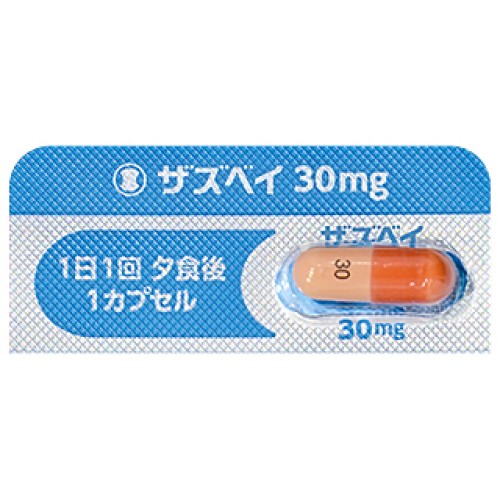
Package details: 14 capsules (7 capsules * 2 PTP)
Active components: zuranolone 30 mg per capsule
Therapeutic effect: Strengthens GABA-A receptor signaling at synaptic and extrasynaptic sites and improves depressive symptoms in adults with depression and depressive state. In the Japanese phase 3 trial, symptom scores fell over a 14-day course.
Dosage and administration: The usual adult dose is 30 mg (one capsule) once a day after dinner for 14 days. Taking it after a meal matters, because a high-fat meal raised the peak blood level about four times and total exposure about 2.3 times compared with fasting. If treatment is repeated, there must be an interval of at least 6 weeks from the end of the previous course, and the need for another course is considered carefully. If symptoms recur after repeated courses, or there is no improvement after 14 days, or symptoms worsen within 6 weeks and drug therapy is needed, your doctor considers other treatments. The medicine is not intended to prevent relapse after symptoms have improved. The dosage can be adjusted by your doctor.
Contraindications and precautions: Do not use if you have had a hypersensitivity reaction to any ingredient, or if you are pregnant or may be pregnant. Teratogenic effects and reduced embryo-fetal survival were seen in rats. Women who may become pregnant need to use contraception during treatment and for 1 week after the last dose. Breastfeeding is considered with your doctor, since zuranolone passes into breast milk.
Do not drive or operate dangerous machinery during treatment, and avoid alcohol. An overdose may cause excessive central nervous system depression, and there is no specific antidote.
Depressive patients may have thoughts of suicide or attempt it, and antidepressants have been reported to raise this risk in patients aged 24 or younger. Patients and families should watch for suicidal thoughts and sudden changes in behavior, and contact the doctor promptly. Tell your doctor if you have bipolar disorder (manic switch may occur), a tendency toward schizophrenia, strong impulsivity, an organic brain disorder, sleep apnea or moderate or worse respiratory disease (breathing may be suppressed). Elderly patients are at higher risk of sleepiness, sedation and confusion. No clinical trials have been done in children


